
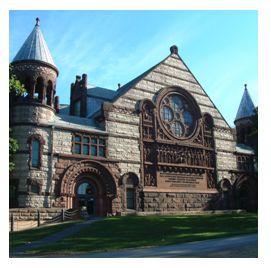
Princeton

Turning university science breakthroughs into businesses

Turning university science breakthroughs into businesses

A superb panel video from Princeton covers just about everything: angel investment, venture capital, intellectual property as well as the academic, engineering and technology licensing perspectives

They’ve even got the political aspect covered, with a moderator who used to be a US congressman and now teaches entrepreneurship at this Ivy League college.

The event was called:

Technology Commercialization Panel: Taking University Inventions to Market

In conjunction with the Jumpstart New Jersey Angel Network, Drinker Biddle & Reath, and the Office of Technology Licensing, the Keller Center hosted a panel discussion on technology commercialisation of university scientific and engineering inventions.

This event was the third in the Princeton Jumpstart Lecture Series on Technology Entrepreneurship for the 2009-2010 academic year.

The event was held on Tuesday, February 16th 2010

The diverse panel was be moderated by Professor Ed Zschau, who has been an entrepreneur and a venture capital investor, as well as a two- term U.S. congressman who currently teaches the popular High-Tech Entrepreneurship course at Princeton.

Panelists:

13 Responses to “Turning university science breakthroughs into businesses”

  1. Rob Jara says:

    While this may sound promising to universities, with all the funding and opportunities for for further discoveries involved, I wonder if such partnerships will prove to be beneficial to universities in the long run.

    • MegVa says:

      I was wondering the same thing, Rob. How the angel investors and venture capitalists are going to benefit from technological commercialization integration in universities was made clear to us in the video, but perhaps the advantages for university-based start-ups could have been addressed more specifically. Maybe in another video in the series?

      • MegVa says:

        I found a link to a PDF that you might find interesting.

        http://www.bio.org/ip/techtransfer/BIO_final_report_9_3_09_rev_2.pdf

        Basically, what it said was that while this sounds pretty exciting and may provoke a lot of debate, technological commercialization in universities is not new. Benefits to the universities would include increased networking range or capability, as venture capitalist or an angel investor will be able to provide new business contacts on a wider scale; and access to the knowledge and business experience of investors and funding groups as well as the university staff and facilities.

        • Rob Jara says:

          Yeah, it has been existing in the US for over 30 years. But to me one problem here is academic integrity. Are these universities being turned into “sled dogs” that churn breakthrough after breakthrough while companies get richer ?

          • MegVa says:

            It’s true that it does sound like the investing companies get more out of this setup than universities, but at least it’s an alternative way to obtain funding, facilities and connections that a university may not be able to provide start-ups and would-be innovators.

  2. Rob Jara says:

    Actually Meg, the more I think of it, it’s becoming clear to me that universities, especially state-funded ones, will suffer more in the long run in these partnerships. Here’s an article that proves my point:

    http://www.mndaily.com/2010/02/16/technology-commercialization-research-revenue

    “But as state appropriations stagnate or decline and federal research budgets are stretched to their limit, alternative sources of revenue have become increasingly critical for public institutions. Royalties from patents, profits from startup companies and fees from licenses can be plowed back into both research and student support. Meanwhile, those startups and licenses are put in the hands of companies to distribute the technology beyond a university’s reach.”

  3. Rob Jara says:

    That’s the scary thing, Meg. Alternative funding sometimes become scapegoats or excuses for the state to turn the tables on state universities or any public institution for that matter. Here in the Philippines, for example, state funds for state universities are being ignored, with the government citing reasons that the universities have the capacity to be self-sustaining. That to me is tantamount to commercialization of not only the breakthroughs provided by universities or schools, but the education as well.

  4. MegVa says:

    That’s one aspect of it that I didn’t think of. Thank you, Rob. I was focusing on the U.S. environment and how technological commercialization has worked (or not worked) for universities there.

    One case is a bit alarming. Kauffman Foundation made an appeal in August of 2010 to the US government to allow an inventor to own patent rights on an invention, as universities commonly take ownership of patents of inventions made within the universities and using federal funding. So if you invent a cure to a debilitating disease while studying in a university, the university owns the patent? This pretty much proves what you said earlier about turning universities into sled dogs.

    • Rob Jara says:

      Not only that Meg, there have been issues also where in the companies have made disputes when it comes to patents and royalties involving inventions and discoveries. Here’s one from the previous link I provided:

      “The multimillion-dollar royalties for that patent did not come easily. Illustrating the complex relationship between universities and big business, the University of Minnesota had to sue the pharmaceutical company, which at the time was called Glaxo Wellcome PLC, to win back the royalties.

      The pharmaceutical company argued that it did not use the University’s patented discoveries to develop the drug, but the University eventually settled the suit and earned the royalties in 1999.”

      The thing is, instead of research, development and technological breakthroughs being seen as a contribution to society, these are being treated as multi-billion business ventures by some. And who stands to suffer the brunt of these abuses? Your guess is as good as mine.

  5. MegVa says:

    There’s also an underlying issue here that’s even more troubling. With all this concern about patents, licenses, intellectual property rights, etc., other modes of innovation are left by the wayside.

    • Rob Jara says:

      Hopefully Meg, start-up companies being involved in university partnerships are more keen on sharing breakthroughs and discoveries, not just on profiting from them.

  6. MegVa says:

    Although applied knowledge/research and commerce go hand in hand, perhaps we should figure out where to draw the line, and how.

    • Rob Jara says:

      And fast. It’s never too late to establish more stringent rules regarding university-company partnerships, as long as the university is taken care of, in terms of funding and further research opportunities, and ultimately, not left out so badly that it has to affect the quality of the education they provide.

Comment on this article